













How to do damage calcs in VGC
A damage calc answers the question that decides many games: if I attack, do I knock it out, and if it attacks me, do I survive? This is how to read a calculator and how to use calcs to build your sets.
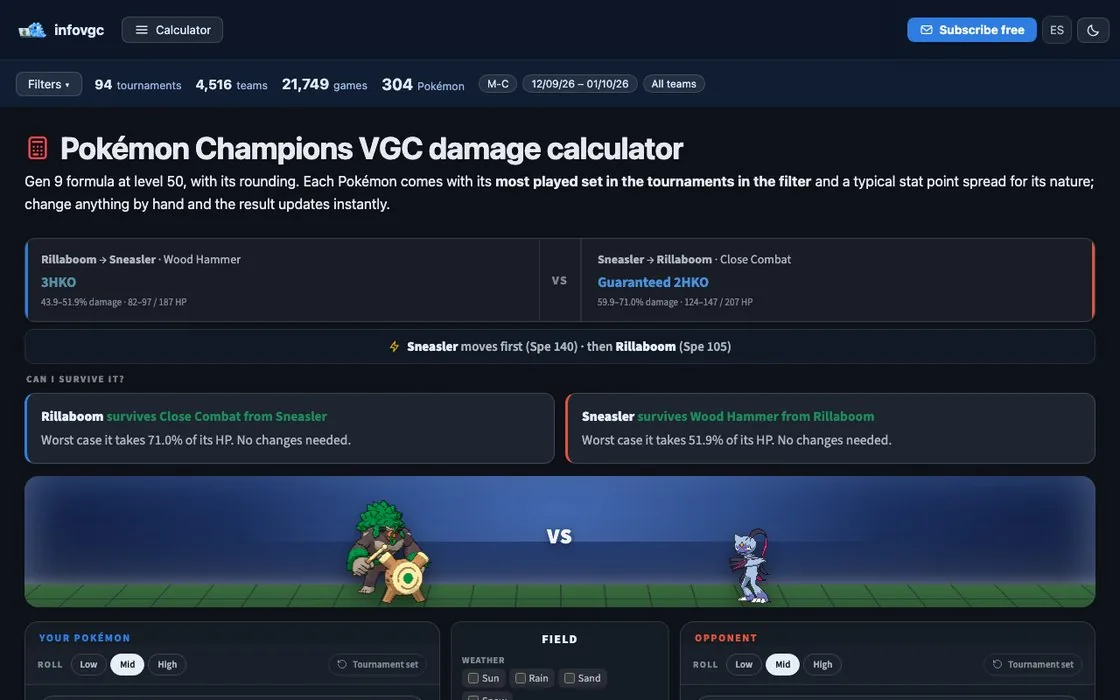

Pick attacker, defender and move
Put your Pokémon on one side and the opponent on the other. On infovgc each one loads with its most played tournament set, so the calc starts from what you will actually face. Then pick the move and look at the result.
How to read the result
Damage comes out as a range, for example 84% to 100%, because every hit has a random factor. If the maximum reaches 100% there is a chance to KO; if the minimum reaches it too, the KO is guaranteed. Anything in between depends on luck.


Add everything on the field
In doubles you almost never attack in a vacuum: there is weather, terrain, screens, Helping Hand, Intimidate or an attack that hits both opponents and therefore does less damage. Set in the calculator whatever is in the game or the number will not help you.



Use calcs to spread stat points
If a very common hit knocks you out by a small margin, the infovgc calculator finds how many HP and defence points you need to survive it and tells you what you give up in exchange. That is how winning teams build their spreads.



The calcs worth knowing
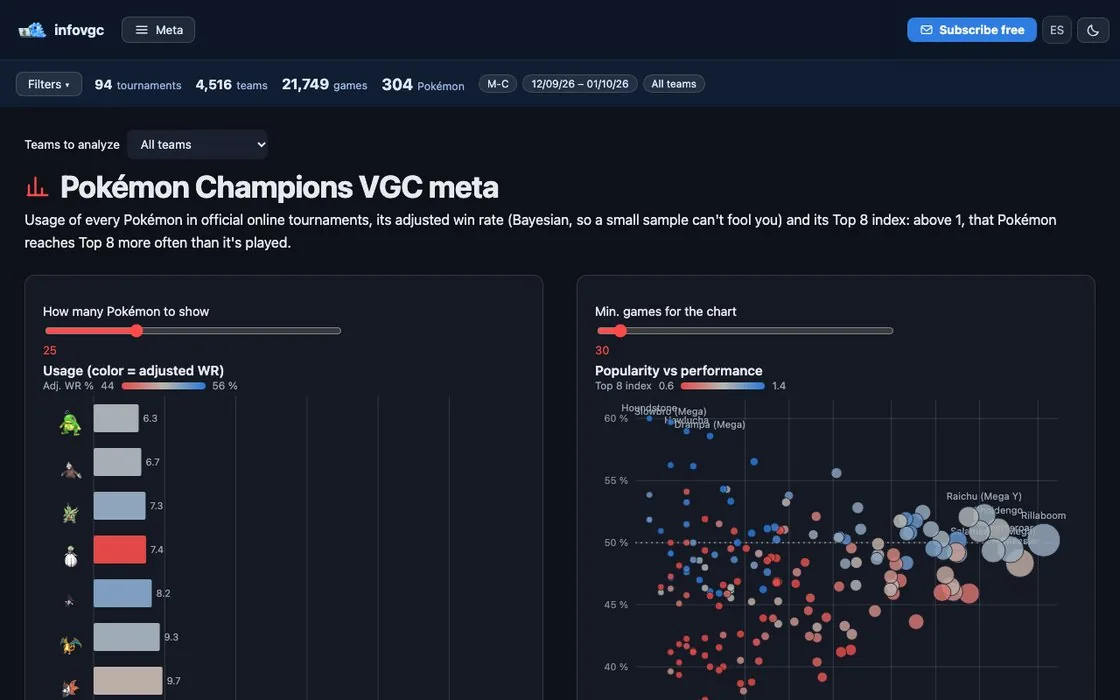
You do not need to memorise everything. Start with the strongest hits from the five most played Pokémon in the meta against yours: those are the ones you will see in almost every game.
Frequently asked questions
Why is damage shown as a range?
Every attack multiplies its damage by a random number between 0.85 and 1. That is why the same hit does not always do the same.
What is an OHKO?
Knocking out in a single hit (One-Hit KO). A 2HKO takes two hits, and so on.
Is the infovgc calculator free?
Yes, like every tool on the site, and you do not need to sign up.
More guides
 01 · 6 min read
How to start playing VGC, step by step
From your first team to your first tournament in eight steps.
Read the guide02 · 5 min readWhat is VGC: competitive Pokémon explained
Doubles, level 50, stat points and best-of-three games.
Read the guide 03 · 6 min read
How to build a VGC team
From a two-Pokémon core to the sixth slot, with data.
Read the guideTry it with real data
Every infovgc tool is free and built on the public team lists of Pokémon Champions tournaments.
Get it in your inbox every Monday
The weekly VGC meta report, free and nothing else. Unsubscribe in one click.